Funding rates explained: who pays, when, and what holding costs
How perpetual funding is set and settled, how to read the funding column on Coinlytic, and what holding a leveraged position through many intervals costs in plain numbers.
On this page
A perpetual future never expires, so no settlement date pulls its price back to spot. Funding does that job instead. It is a payment between traders at fixed times, and for anyone holding leverage longer than a few hours it is a running cost that belongs in the plan.
A transfer between traders, not an exchange fee
Bybit describes funding as an exchange made directly between long and short position holders at each funding time. A positive rate means the long side pays the short side; a negative one reverses the flow.
The amount is position value × rate, where position value is contract quantity × mark price. Margin and leverage are not in the formula. Two traders with the same position pay the same amount, whether they posted 10% or 50% of it as margin.
When it is charged
On an 8-hour contract, Bybit settles at 00:00, 08:00 and 16:00 UTC. Not every pair uses 8 hours, and Bybit states that a contract whose rate reaches its preset limit at settlement switches to hourly settlement.
Only positions open at the timestamp pay or receive. A position closed before it owes nothing for that interval; one opened a minute before it pays the full rate.
If the available balance cannot cover a payment, Bybit takes it from the position's margin. In isolated mode that moves the liquidation price closer.
How the rate is set
Bybit's rate has two parts. The interest component is 0.03% per day, which is 0.01% per 8-hour interval. The average premium index measures how far the contract's order book trades above or below the index price, with more weight on readings near the end of the interval.
The formula takes the premium and adds the gap between interest and premium, with that gap capped at ±0.05%. One consequence follows from the arithmetic: while the average premium stays between −0.04% and +0.06%, the rate comes out at exactly 0.01%. Only a premium outside that band moves it.
The live figure is an estimate. It updates every minute and becomes final only at the funding time.

Reading the funding column on Coinlytic
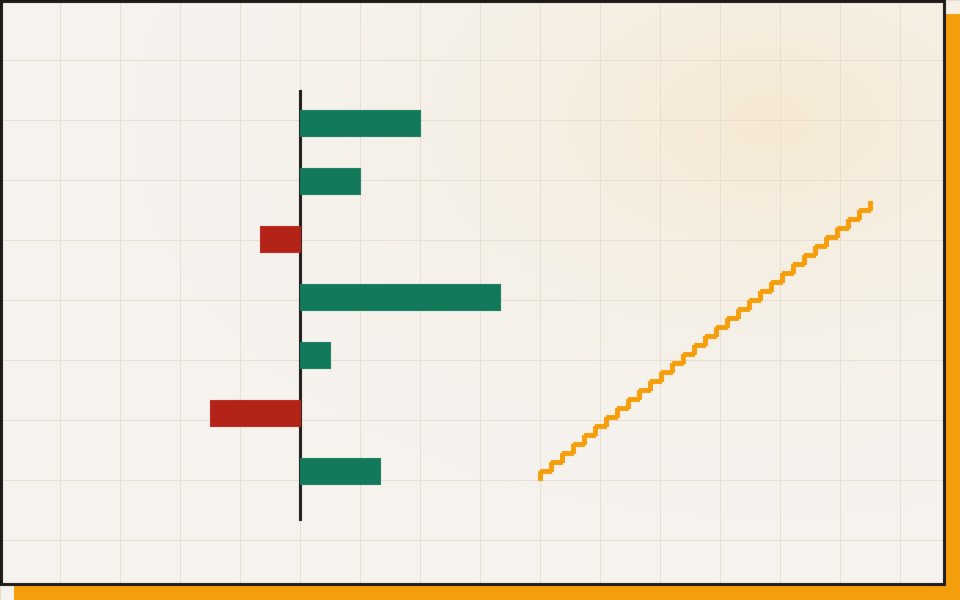
The Perpetual futures panel on the Coinlytic home page reads Bybit USDT perpetuals. The column heading shows the interval in hours. Each coin's rate is drawn as a bar from a centre line: right and green when longs pay, left and red when shorts pay. Bars are scaled to the largest absolute rate in the panel, so a long bar means large compared with the other coins right now, not large in absolute terms.
Hover over a rate to see it annualized: rate × intervals per day × 365. That assumes the rate never changes, so treat it as a unit conversion, not a forecast. It also makes intervals comparable: 0.01% every 8 hours is 0.03% a day, while 0.01% every hour is 0.24%, eight times as much (10.95% against 87.6% annualized).
What holding costs: a worked example
Assumptions: a long of 0.2 BTC at a mark price of 40,000 USDT, so a position value of 8,000 USDT, opened with 2,000 USDT of margin (4×). The mark price is held constant to isolate funding. Three hypothetical rates per 8 hours:
- 0.01%: 0.80 USDT per payment, 2.40 a day, 72 USDT over 30 days. That is 0.9% of the position and 3.6% of the margin. Annualized: 10.95%.
- 0.03%: 2.40 USDT per payment, 216 USDT over 30 days, or 10.8% of the margin.
- 0.10%: 8 USDT per payment, 24 a day, 720 USDT over 30 days. That is 9% of the position and 36% of the margin. Annualized: 109.5%.
The short on the other side receives the same amounts. Because funding is charged on notional, the share of margin it consumes grows with leverage: at 8×, the 0.10% case would take 72% of the margin in a month.

What extreme funding tells you, and what it does not
A rate far from 0.01% says the perpetual traded at a persistent premium or discount to the index, and that one side kept paying to hold its exposure. That is a fact about the cost of positioning. It is not a direction.
- It does not say how big the crowded side is. A high rate on a coin with little open interest moves less money than a modest rate on a large one.
- It does not say when anything changes. A rate can stay elevated for many intervals.
- It does not mean forced selling is coming, only that the paying side carries a higher cost while it waits.
- Until settlement, the live number is provisional.
Questions for a written plan
- What does funding cost per day at the current rate, and what share of my margin is that over the period I expect to hold?
- Does this contract settle every 8 hours, or more often?
- Would a rate several times today's level change whether the trade still makes sense?
- Is my available balance large enough that a payment never comes out of isolated margin?
For education only, not financial advice. Trade examples are illustrative. Crypto prices are volatile, and leveraged trading can lose more than your margin.
Get one trade plan like this each week
Setup, stop, size and review in one email. Free, unsubscribe anytime.
Mid-week market-structure notes on Telegram: @ispsjaolqMarket brief
Latest news