- CAT
- Risk management
- DATE
- October 21, 2026
- READ
- 4 min read
- SRC
- CryptoSlate
Crypto liquidation risk: Binance reprices bStocks off-hours
Binance will value bStocks collateral around the clock from Oct. 24. What weekend repricing means for margin levels, uniMMR and liquidation risk.
[≡] On this page06
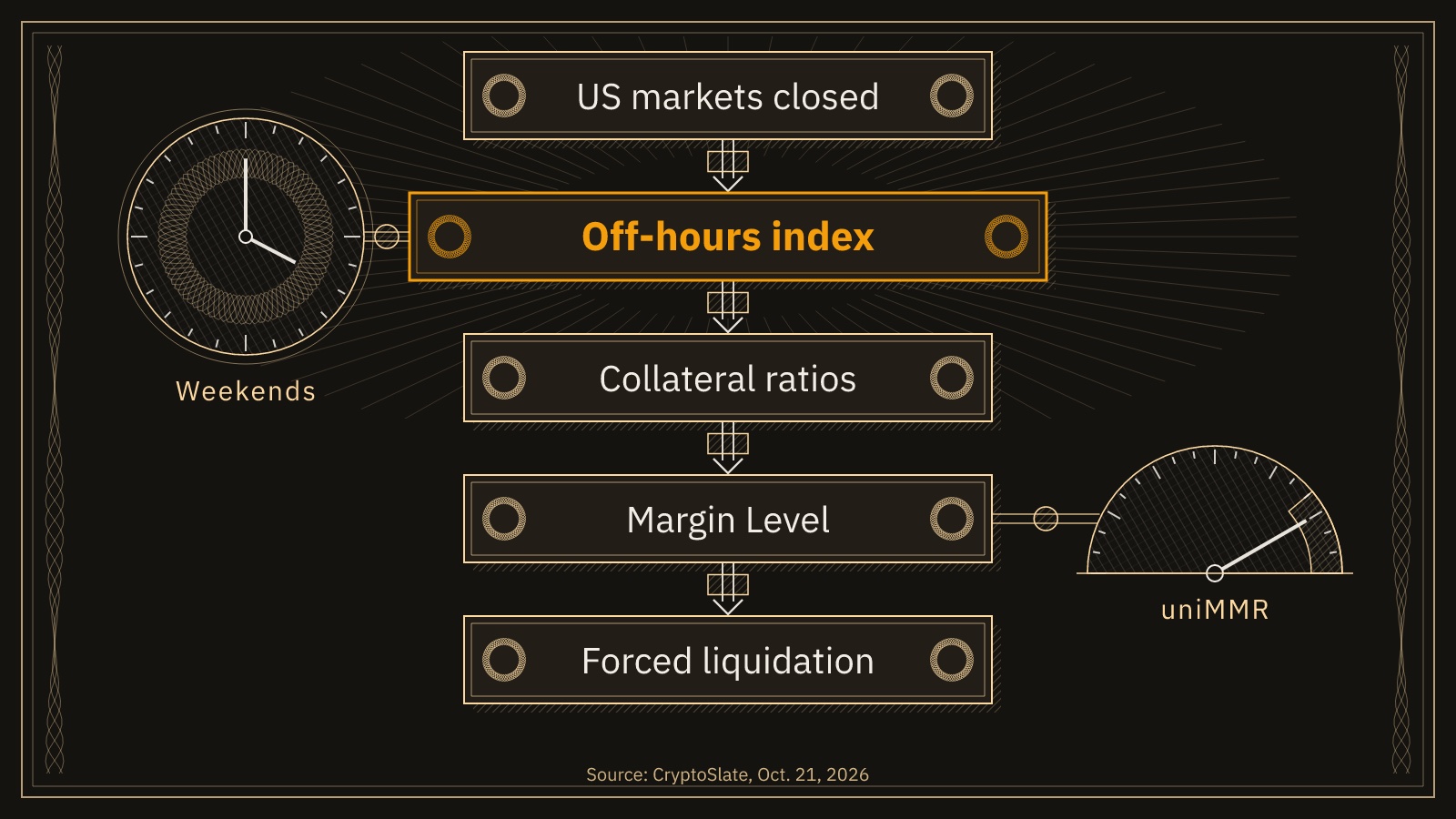
Starting at 00:00 UTC on Oct. 24, Binance will revalue bStocks collateral continuously, including weekends and holidays when US stock markets are closed, CryptoSlate reported on Oct. 21. For traders who post tokenized stocks as margin, the change means the value backing their positions can now move on a Saturday. This article looks at how the new pricing works and what it does to liquidation distance.
What Binance changed
bStocks are tokenized securities on Binance that track US-listed equities. They give price exposure only. Holders do not own the underlying shares and get no shareholder rights.
According to CryptoSlate, a Binance notice dated Oct. 20 sets continuous updates for the bStocks collateral index. From Oct. 24, when outside market data is not available, such as on weekends, holidays and during daily maintenance windows, the index will reference prices from Binance's own trading.
How the off-hours price is built
In off-hours mode the index uses an orderbook Impact Mid Price. That is a midpoint taken from the depth of the order book rather than the last trade. Binance then smooths it with an exponentially weighted moving average, or EWMA. The effect is that collateral value does not jump with every short-lived move in a thin weekend book.
Two further controls apply. A movement cap limits how far the index can shift while in off-hours mode. CryptoSlate notes its size is not stated and Binance may change it. When the index leaves off-hours mode, Binance phases gradually from the old calculation to the new one, so the switch back is not a single step.
Crypto liquidation risk: where the change bites
Crypto liquidation happens when an account's margin falls below the level the exchange requires, and the exchange closes positions to cover the shortfall. Binance's collateral FAQ says forced liquidation can follow once an account breaches its liquidation threshold.
The path runs through valuation. Binance first values bStocks with the index, then applies collateral ratios that decide how much of that value counts as margin. If the bStocks value drops while everything else in the account is unchanged, the same positions now rest on less support. The account sits closer to its threshold without the trader opening anything new.
Binance warns directly that Margin Level and the Unified Maintenance Margin Ratio, or uniMMR, can change while US markets are shut. A lower collateral value can push both down. A trader should not assume stock-token collateral stays fixed while US markets are shut. The risk type here is liquidity risk on the collateral side: weekend prices come from Binance's own book, and its depth was not disclosed, so thin books are a risk to check.
Who is affected
Three Binance account modes accept eligible bStocks as margin: Portfolio Margin Pro, Portfolio Margin and Cross Margin, with eligibility and jurisdiction limits. Users at VIP 0–2 levels must complete a suitability questionnaire first. Collateral ratios can differ by token and may change over time, so two bStocks positions of similar size can carry different weight.
Holders in Cross Margin or Portfolio Margin may also face extra trading restrictions under specified risk conditions. Binance's FAQ says those restrictions alone do not force-close positions. They are separate from liquidation, but they can limit what a trader can do while margin is thin.
What a trading plan should re-check
Cross and portfolio margin pool collateral across positions. That is efficient, but it means a weekend move in one stock token can reduce support for an unrelated crypto perp. A written plan should treat bStocks collateral as live risk, not as a static buffer.
- If my bStocks collateral fell over a weekend while crypto stayed flat, how much room would my uniMMR or Margin Level have left?
- Do I know the current collateral ratio for each bStocks token I hold, and would I notice if it changed?
- Is my position size set from the distance to liquidation under a weaker collateral value, not today's value?
- Can I add margin or reduce exposure during off-hours if the account moves toward its threshold?
None of these questions depends on a view of where any stock or coin is going. They are about how much buffer the account has when one input moves on its own.
What to watch next
The first test comes on the first weekend after Oct. 24. Traders using bStocks as margin can watch how far the off-hours index drifts from Friday's close and how smoothly it rejoins outside data. Binance has not disclosed the movement cap, and it reserves the right to change it, so any update to that setting or to collateral ratios is worth tracking in the exchange's notices.
Sources
- CryptoSlate · October 21, 2026
Written with AI assistance from the reports named above. Figures, quotes and sources are checked automatically before publishing.
For education only, not financial advice. Trade examples are illustrative. Crypto prices are volatile, and leveraged trading can lose more than your margin.
Get one trade plan like this each week
Setup, stop, size and review in one email. Free, unsubscribe anytime.
Mid-week market-structure notes on Telegram: @ispsjaolq