- CAT
- Market data
- DATE
- October 31, 2026
- READ
- 5 min read
- SRC
- Coinlytic Telegram channel +1
ICE Plans US Hyperliquid Perpetuals as HYPE Surges
ICE and Trade[XYZ] plan US retail perpetuals routing to Hyperliquid. Coinlytic analyzes the clearing structure, margin risks, and HYPE market moves.
[≡] On this page06
Intercontinental Exchange has announced a venture with Trade[XYZ] to introduce perpetual futures contracts to United States markets. The proposed infrastructure connects regulated clearing systems with on-chain order flow from Hyperliquid, sparking an immediate rally in the platform's native token.
Regulated Clearing Meets On-Chain Perpetuals
Intercontinental Exchange, the parent entity of the New York Stock Exchange, unveiled plans to bring perpetual contracts developed by Trade[XYZ] into the domestic American financial system. To execute the initiative, ICE acquired a minority holding in Trade[XYZ] with the objective of operating compliant trading venues and establishing a retail platform titled ICE[XYZ]. Cointelegraph reported that the structure intends to bridge on-chain decentralized liquidity directly with regulated clearinghouses.
Perpetual contracts have historically operated outside United States regulatory boundaries for retail participants. Under the proposed arrangement, the entities plan to petition regulators for retail perpetual offerings covering crypto assets, equities, market indexes, commodities, and foreign exchange. Contract distribution is planned to occur in conjunction with OKX, leveraging a joint structure formed after ICE invested at a valuation of $25 billion in OKX during March.
Analytics provider DefiLlama ranks Hyperliquid as the largest decentralized venue worldwide for perpetual futures trading. Channelling order flow from an established decentralized exchange into a traditional clearinghouse requires solving critical structural frictions. In standard centralized derivatives, settlement and margin verification occur within closed clearing systems. Connecting decentralized liquidity pools to regulated brokerage accounts introduces distinct compliance layers, custody requirements, and settlement timelines that traders must account for in their risk models.
What Are Crypto Futures When Structured for Retail Margins?
Crypto futures represent standardized agreements to buy or sell an underlying digital asset at a specified price. While traditional dated futures expire on a predetermined calendar day, perpetual contracts roll over continuously without an expiry date, relying on automated funding payments between long and short traders to keep contract values anchored to spot index benchmarks.
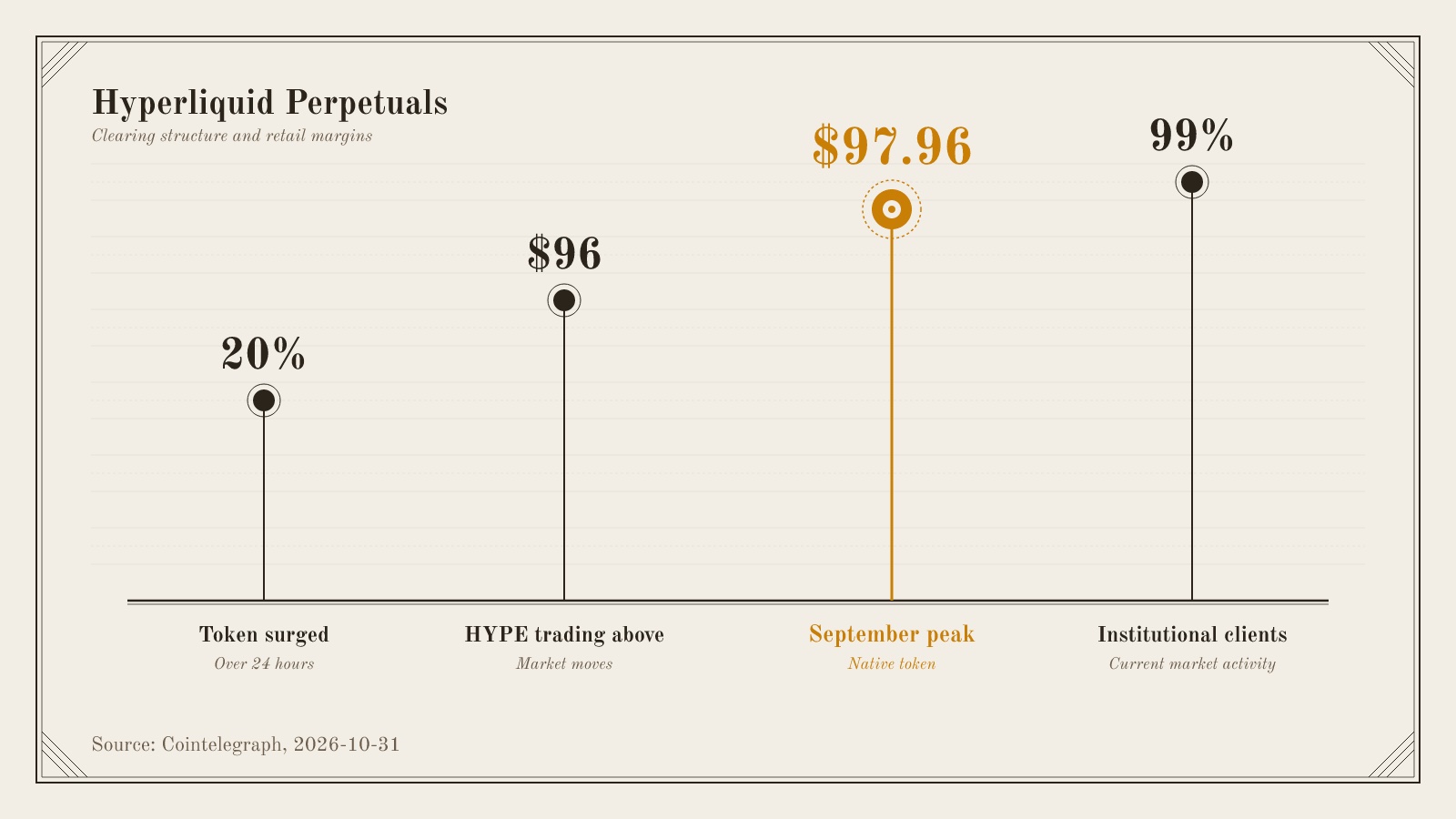
The expansion of perpetual contracts into American regulatory territory alters how margin and default hazards are segmented. Cointelegraph noted that institutional clients currently account for More than 99% of market activity in these cleared segments. Because institutional desks operate under stringent capital allocation rules, ICE is establishing an isolated clearing framework specifically engineered to shield institutional participants from retail default hazards.
In unsegregated derivatives venues, severe market volatility can trigger widespread liquidations that overwhelm exchange insurance funds, occasionally resulting in auto-deleveraging or generalized socialized losses. An isolated clearing architecture ring-fences retail brokerage margin from institutional balance sheets. For leveraged retail traders, this design means margin calls, liquidation triggers, and maintenance requirements will be enforced strictly by participating brokerages under existing futures commission merchant rules, rather than relying solely on autonomous on-chain liquidation bots.
Token Volatility and Market Reaction Around HYPE
Market participants responded immediately to the corporate announcement on Thursday. Hyperliquid native token HYPE surged about 20% following the news. CoinGecko data showed HYPE trading above $96, gaining around 20% over 24 hours and nearing its September peak of $97.96.
A rapid spot and derivatives rally toward previous historical peaks typically creates intense volatility and changes the mechanics of position management. When an asset nears an established resistance level such as $97.96 after a sudden 20% intraday advance, short-dated momentum positions face elevated liquidation risk if market depth thins. High volatility across decentralized exchanges often leads to sudden spikes in borrowing fees and collateral utilization.
Prominent Wall Street investor Stanley Druckenmiller backed Trade[XYZ], stating to Cointelegraph, "I am excited to be an investor in trade(xyz)". Public attention increased further when Elon Musk responded to the news with the single word Interesting. While high-profile endorsements frequently accelerate retail momentum and speculative open interest build-ups, they also increase market sensitivity to regulatory updates. Leverage deployed during momentum spikes exposes positions to sharp mean-reversion pullbacks whenever follow-through buying slows.
Regulatory Hurdles and Clearinghouse Mechanics
Despite the partnership structure, launch timing remains subject to mandatory government authorization. Commodity Futures Trading Commission regulatory approval is required before launch, meaning the exact deployment timeline depends on agency authorization. Retail clients will also be required to satisfy identity and Anti-Money-Laundering screening before executing trades via participating futures brokerages, removing the pseudo-anonymous onboarding standard common in decentralized finance.
Regulatory precedent for retail perpetuals remains limited in the United States. While Kalshi secured CFTC approval for its Bitcoin perpetual contract in May, regulators noted perpetuals tracking different asset classes must undergo individualized evaluations. Approval for a single cryptocurrency perpetual contract does not grant blanket authorization for contracts tracking equities, commodities, foreign exchange, or altcoin indices.
Executive commentary has highlighted political attention on the derivatives space. On Aug. 19, President Donald Trump stated that CFTC Chair Michael Selig aimed to facilitate Hyperliquid's entry into the domestic market compliantly. Nonetheless, each unique asset contract submitted by ICE and Trade[XYZ] will face individual CFTC clearing and surveillance reviews to determine whether margin buffers adequately protect market participants against sudden liquidity shocks.
Position Management and Leverage Checklist
Traders evaluating market structure developments across both decentralized venues and regulated clearing venues should review their core margin parameters. Integrating regulated execution rails with decentralized liquidity changes how slippage, liquidation priority, and counterparty risks operate during market stress.
Before initiating or holding positions in volatile tokens reacting to market structure headlines, traders should verify the following points:
- Does your margin model separate the risks of autonomous decentralized liquidation from regulated brokerage margin calls?
- How does holding through key technical levels, such as the September peak of $97.96, affect your maximum liquidation distance?
- Are you accounting for potential basis divergence between on-chain perpetual funding rates and regulated futures settlement benchmarks?
- Is your position sized small enough to withstand a sharp reversal after an intraday advance of roughly 20%?
Structural Factors to Monitor Next
The primary variable governing market development is formal CFTC documentation regarding ICE[XYZ] clearing applications. Traders should track regulatory filings to determine whether margin rules for proposed perpetuals require higher baseline collateral than offshore or purely decentralized counterparts.
Additionally, market participants should watch liquidity transfer between on-chain Hyperliquid contracts and regulated brokerage accounts. If significant order flow transitions toward compliant clearing hubs, liquidity depth on primary decentralized books could shift, impacting slippage on large liquidations. Until official authorizations are finalized, price action around HYPE and perpetual market liquidity will continue to reflect speculative positioning rather than finalized clearing volume.
Sources
- Coinlytic Telegram channel · October 30, 2026
- Cointelegraph · October 29, 2026
Written with AI assistance from the reports named above. Figures, quotes and sources are checked automatically before publishing.
For education only, not financial advice. Trade examples are illustrative. Crypto prices are volatile, and leveraged trading can lose more than your margin.
Get one trade plan like this each week
Setup, stop, size and review in one email. Free, unsubscribe anytime.
Mid-week market-structure notes on Telegram: @ispsjaolq