- CAT
- Market data
- DATE
- November 3, 2026
- READ
- 4 min read
- SRC
- CryptoSlate
Arthur Hayes Proposes Dollar Compute Futures
Arthur Hayes proposed dollar-settled compute futures and perpetual swaps. Here is how quanto pricing, rollover mismatch, and basis risks work.
[≡] On this page04
Arthur Hayes has introduced a blueprint for crypto and traditional venues to list quarterly futures and perpetual swaps tracking AI compute prices. As reported by CryptoSlate, the design relies on dollar margin and dollar settlement to hedge compute capacity. This article analyzes how quanto pricing adjustments, index replication, and forward rollover schedules alter position mechanics for derivatives traders.
Contract Design and Index Mechanics
Arthur Hayes proposed a blueprint on October 26 for crypto and traditional exchanges to list quarterly futures and perpetual swaps linked to AI compute costs, according to CryptoSlate. Under the framework, the planned derivatives contracts track an hourly volume-weighted FLOP/GigaFLOPS benchmark called the Flop Reference Compute Rate, or FRCR.
To simplify cash flows for institutional capacity hedgers, Hayes designed the quarterly futures contract to settle in US dollars with USD margin and a contract multiplier set at $1 per index point. Under this linear specification, payout calculations mirror standard cash-settled index futures. For example, a trader holding one long contract entered at 100 points would receive $100 before transaction costs if the index settled at 200 points.
Because margin and settlement are denominated entirely in dollars, market participants do not need to post physical GPU resources or native project tokens to secure baseline contract margin.
Quanto Adjustments and Currency Basis Risk
While cash settlement simplifies margin handling, structuring synthetic compute exposure introduces complex pricing relationships. Hayes stated that valuing his planned quanto contracts demands an adjustment for the co-movement between the compute benchmark and the FLOP-USD valuation. When derivatives pay out in one currency while tracking an underlying priced in another unit, covariance between the two variables directly shifts the forward curve.
A dollar-settled futures gain can leave buyers exposed to currency swings if the underlying FLOP token price shifts independently of the index. For example, a hedger offsetting compute operational expenditures could capture dollar gains on the derivative while the local purchasing power against token-denominated hardware hours deteriorates.
Hedging desks seeking to replicate synthetic exposure to the benchmark face structural friction as well. Replicating synthetic exposure to the benchmark requires holding specialized FLOP Compute Units, known as FCUs, weighted to match the underlying index basket. Tracking error between synthetic FCU baskets and the published FRCR index creates basis risk that market makers must price into spreads.
Rollover Structure and Tenor Mismatches
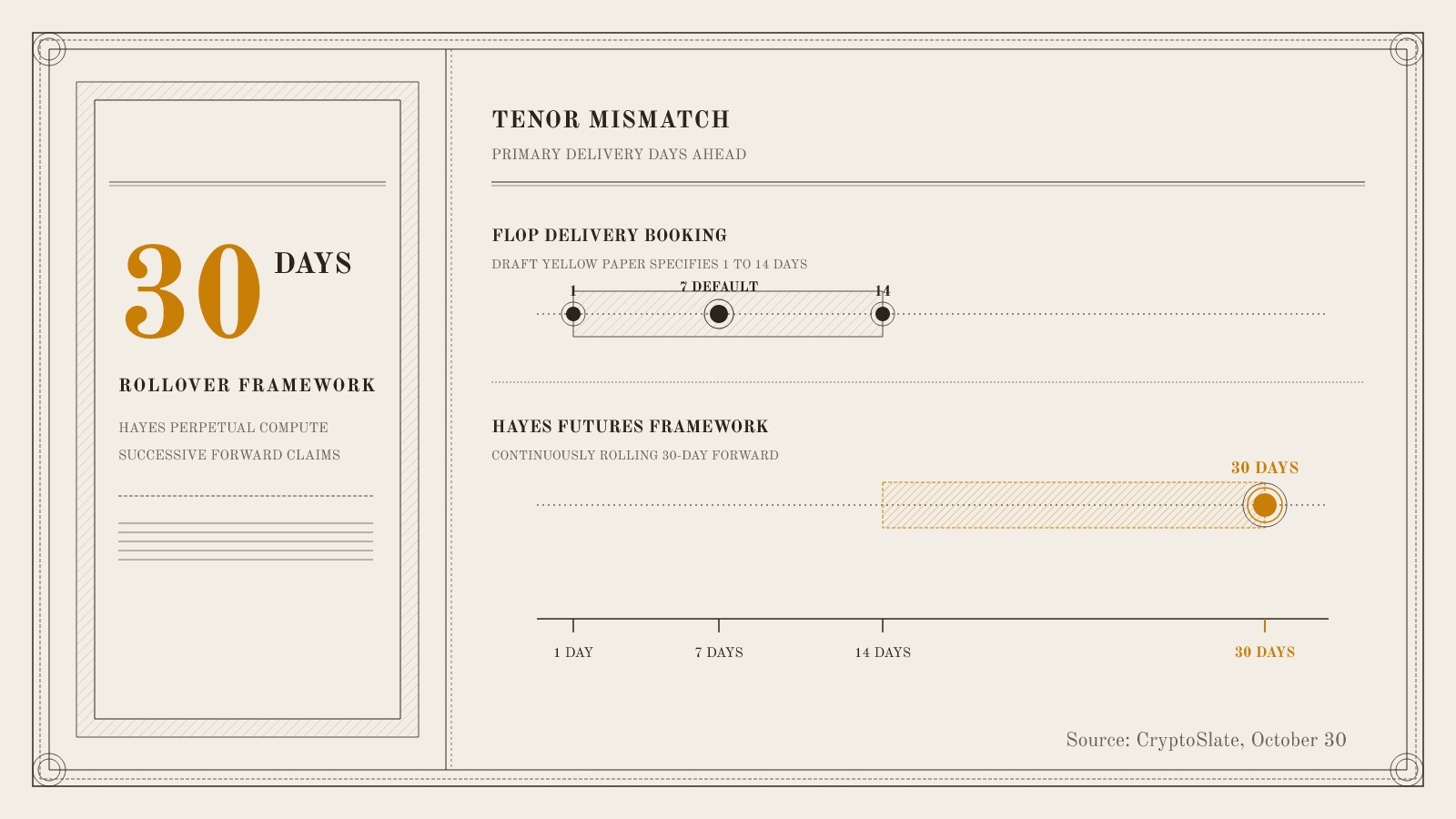
Perpetual synthetic exposure relies on how derivative claims get maintained across settlement windows. Hayes suggested establishing perpetual compute market exposure by continuously rolling successive 30-day forward claims over time. However, this model faces divergence against the operational realities of compute resource allocation.
The FLOP draft yellow paper specifies primary delivery booking from one to 14 days ahead with seven days ahead as default, contrasting with Hayes's 30-day framework. This discrepancy creates term-structure basis risk for liquidity providers trying to cross-hedge deliverable capacity against perpetual contracts.
Furthermore, settlement collateral rules differ between cash derivatives and physical capacity networks. Forward contracts demand fully funded buyer commitments alongside provider performance bonds denominated in FLOP tokens to secure delivery. A trader managing leverage on a centralized or decentralized exchange would post USD variation margin, yet arbitrageurs linking that market to native providers must lock capital in bonded tokens.
Development Status, Regulation, and Trader Checklist
Traders evaluating compute benchmarks should note that underlying cash liquidity remains non-existent. Documentation updated October 30 indicates that FLOP Network functions solely as a test development network without real money or circulating tokens. The platform established provisional launch dates of November 3 for its testnet and Q1 2027 for mainnet release and token generation.
Regulatory scrutiny is also developing alongside market blueprints. On August 19, the CFTC initiated a consultation exploring perpetual futures, cash-market liquidity, customer safeguards, and manipulation risks in compute markets. Because synthetic compute relies on volume-weighted benchmarks that lack deep secondary spot markets, cash manipulation and oracle latency remain primary structural concerns for regulators and exchanges.
- How does covariance between the FRCR benchmark and FLOP-USD affect the implied quanto premium on the contract?
- Does the rollover frequency align with physical delivery commitments (seven-day default vs 30-day forward curve)?
- What is the liquidity depth of the underlying FCU components used by market makers to hedge synthetic quotes?
- Are capital requirements tied to USD variation margin or exposed to token performance bond volatility?
Watching testnet metrics on November 3 and tracking exchange listing rules will clarify how venues balance margin models against compute index volatility.
Sources
- CryptoSlate · November 2, 2026
Written with AI assistance from the reports named above. Figures, quotes and sources are checked automatically before publishing.
For education only, not financial advice. Trade examples are illustrative. Crypto prices are volatile, and leveraged trading can lose more than your margin.
Get one trade plan like this each week
Setup, stop, size and review in one email. Free, unsubscribe anytime.
Mid-week market-structure notes on Telegram: @ispsjaolq