- CAT
- 风险管理
- DATE
- 2026年11月13日
- READ
- 阅读约需 4 分钟
- SRC
- Coinlytic Telegram channel +1
Crypto Liquidations Hit $730M as Bitcoin Tests Lows
Over $730 million in derivatives positions were liquidated as Bitcoin fell below $72,000. Here is how perpetual markets absorb the leverage flush.
[≡] 本页内容06
Derivatives order books absorbed sharp selling pressure as Bitcoin fell below $72,000, setting its lowest valuation since Aug. 20. Forced margin liquidations surged across centralized venues as long traders were squeezed out of crowded positions across perpetual contracts and futures markets. This analysis reviews the liquidation figures, explains the mechanical drivers behind cascading margin calls, and examines the risk metrics shaping perpetual futures.
Liquidations Accelerate Across Derivatives Desks
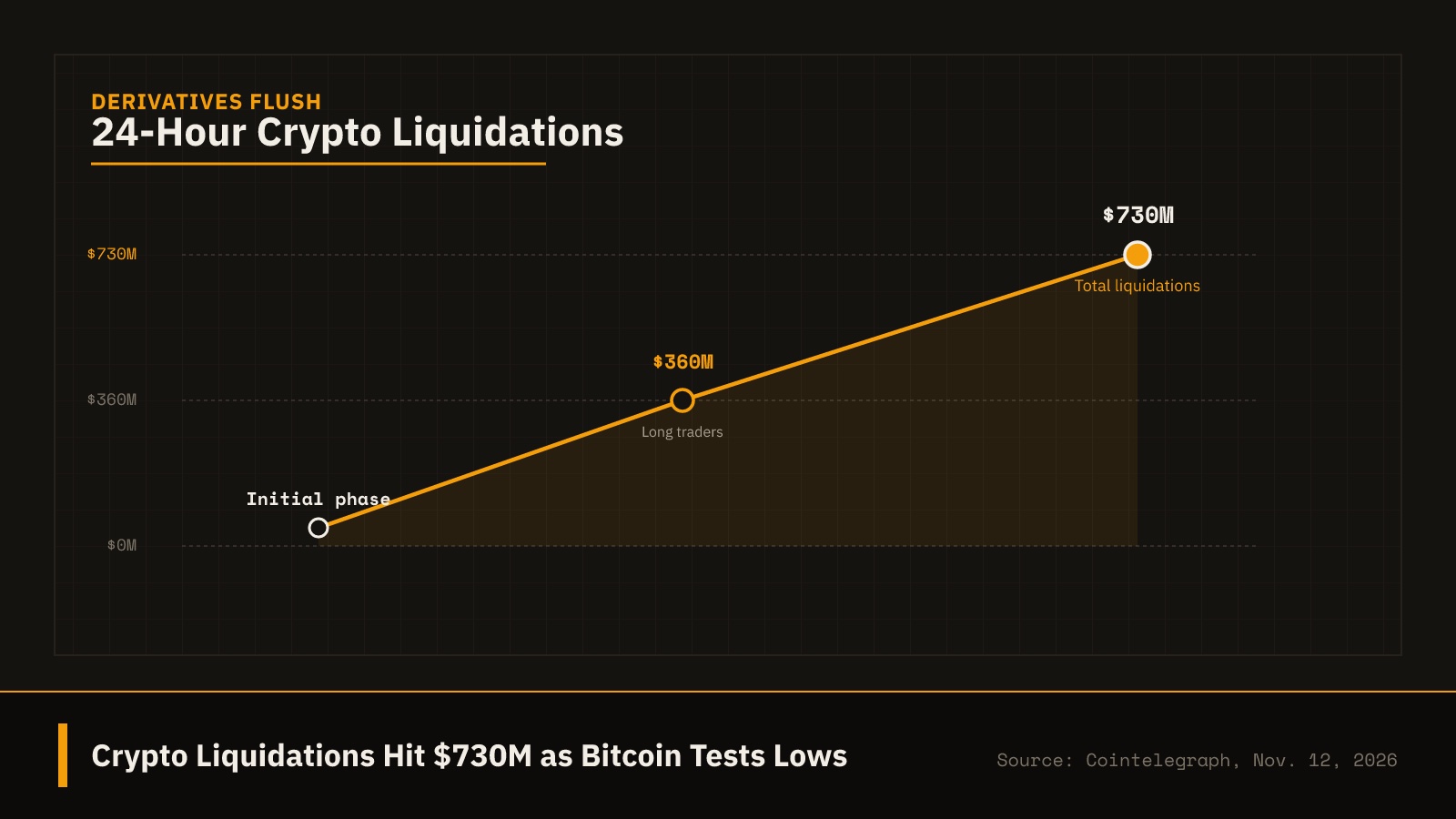
Market participants faced intense volatility as month-to-date Bitcoin losses reached 7.4%. According to data reported by Cointelegraph, 24-hour liquidations across digital asset venues hit $730 million as spot prices cut through concentrated layers of bid liquidity.
An earlier update from the Coinlytic Telegram channel highlighted that nearly $360 million in crypto positions had been wiped out during an initial 24-hour phase, with long traders absorbing the vast majority of the damage. Options open interest had clustered heavily around the $72,000 strike zone, marking a critical threshold where cascading liquidations accelerated.
The selloff coincided with macro volatility in traditional equity markets. Nvidia shares dropped nearly 13% at the Wall Street open after CEO Jensen Huang stepped down. Nvidia named Chief Financial Officer Colette Kress as interim chief executive officer while searching for a successor. The tech-focused Nasdaq Composite Index traded 0.6% lower during the session, showing that broader risk aversion was spreading across both equity and crypto trading desks.
Macro Drivers and Margin Pressures
Macro catalysts continue to influence capital allocation across leverage platforms. Tuesday Consumer Price Index numbers printed above forecasts, prompting bond traders to price in additional Federal Reserve rate hikes.
Market analyst Keith Alan from Material Indicators observed that Friday Producer Price Index figures could influence December rate odds. When interest rate expectations shift upward, liquidity providers widen their bid-ask spreads on perpetual order books, increasing slippage during sharp liquidations.
As bid liquidity thinned out, technical indicators registered breakdowns across multiple timeframes. Bitcoin dropped under its 21-week simple moving average, which stood at $73,078 on Wednesday, triggering programmatic selling from quantitative trading desks that manage systematic trend-following strategies.
How Liquidation Cascades Develop in Perpetual Markets
To understand why liquidations expanded so rapidly, traders must inspect the mechanical plumbing of crypto derivatives venues. In a perpetual contract, traders borrow leverage against an initial margin deposit. If the underlying index price moves against an open position, the trader's maintenance margin ratio deteriorates.
When price reaches the liquidation threshold, exchange risk engines intervene automatically. The engine takes custody of the underwater position and sends aggressive market orders to close the contract against the public order book. In liquid markets with deep limit orders, these forced sales are absorbed with minimal price disruption.
However, during severe market stress, limit buyers step away and cancel resting bids. When $730 million in positions hit thin books simultaneously, each liquidation pushes the mark price lower. That lower mark price instantly triggers the next cluster of stops and maintenance margin violations on other accounts. This recursive feedback loop is known as a liquidation cascade, and it frequently drives derivatives prices below fair value before order books discover balanced two-way liquidity.
Funding Rates and Crowded Positioning
Perpetual contracts do not have a calendar expiry date like traditional quarterly futures. To keep the perpetual market price tied to the underlying spot asset, exchanges implement an eight-hour funding rate mechanism. When perpetual prices trade at a premium to spot, longs pay shorts. When perpetuals trade at a discount, shorts pay longs.
Prior to sharp liquidation events, funding rates often stay positive even as spot momentum fades. This asymmetry signals that speculative traders are stubbornly holding leveraged long exposure, relying on hope rather than cash inflows. When macro events or large sell orders break key support levels, these crowded long positions become liquidity fuel for market makers.
Once the cascade completes and forced liquidations exhaust resting margin calls, funding rates typically collapse toward neutral or negative territory. A reset in funding indicates that excess leverage has been flushed from the system, transferring open interest from fragile leveraged retail accounts to well-capitalized market-making desks.
What the Derivatives Metrics Show
Coinlytic tracks derivatives conditions against spot reference benchmarks. Based on MEXC daily closes as of 2026-11-13, Bitcoin recorded a last close of $71,108. The asset has dropped down 6.2% over 7 days and down 12.9% over 30 days, while retaining a gain of up 13.0% over 90 days.
Against the 50-day simple moving average of $80,676, the current close sits below it by 11.9%. Trading below this benchmark reflects ongoing structural caution across perpetual funding rates and signals that intermediate momentum remains defensive.
Across the 90-day cycle, Bitcoin remains bounded between the 90-day high of $86,619 set on 2026-09-21 and the 90-day low of $62,909 recorded earlier in the cycle. The current price trades 17.9% beneath that cycle high, demonstrating how leverage unwinds compress market valuations during risk-off regimes.
Managing Risk During Leverage Flushes
When 24-hour liquidations surpass $700 million, derivatives traders face elevated auto-deleveraging risks and sudden funding volatility. Long positions entered during temporary bounces carry heightened danger if order-book depth remains shallow and exchange insurance funds are called upon to absorb bad debt.
Professional position sizing requires factoring in market volatility and liquidation buffers. Rather than using maximum leverage, disciplined participants calculate position size based on a predefined dollar stop loss, ensuring that liquidation price rests far below structural support zones.
Traders should monitor whether open interest stabilizes or continues bleeding lower before committing new leverage. Watching the spread between spot index prices and perpetual marks provides early confirmation of when aggressive liquidations subside and sustainable market depth returns.
资料来源
- Coinlytic Telegram channel · 2026年11月11日
- Cointelegraph · 2026年11月12日
本文在 AI 协助下撰写,依据上方列出的媒体报道。数字、引语和来源在发布前均经过自动核查。
仅供学习参考,不构成投资建议。交易示例仅作示意。加密货币价格波动很大,杠杆交易的亏损可能超过你的保证金。